Friday, November 5, 2010
Why Candy on Halloween?
This year, I asked myself, “Why candy on Halloween?” as I set out to buy Halloween goodies for the eager little ones that were prepared to go from door-to-door asking for a treat.
At a time in our country where we are faced with rates of obesity among children as high as 17% and with the reality that our children will be less healthy than we are, why are we giving our children more empty calories to solidify their fate?
This year, I vowed to think outside of the box on this and try a little social experiment of my own. From what I can tell, Halloween’s early beginnings didn’t just involve children getting candy, but required some responsible action on their part as well.
In Scotland and Ireland, children trade candy for a poem or a joke. In Canada, the treat was literally an effort to keep the children responsible by not doing tricks. “Why then, can’t I have a requirement for my treats?” I thought. So this year, my husband and I decided that every piece of candy we gave came with an apple, pretzels or a 100-calorie popcorn ball. I liked to call it my own social experiment.
Although, I definitely got some strange looks as I passed out treats at my trunk (my kids are part of the generation that does trunk-or-treating which involves decorating your car and passing out candy to kids from your trunk), I was pleasantly surprised by the number of kids who on both days of trunk-or-treating (we did it on Saturday at our son’s karate school and on Sunday at our church) were not just excited about their shiny new apple, but told their friends who then came over and asked, “are you the lady giving away apples?”
I can’t tell you how proud I felt to see that all was not lost.
The reality for me was that if Halloween treats originated as apples and oranges and other healthy snacks, today’s kids might be as excited receiving these treats as the kids that dropped by my trunk. It solidified for me how critical the choices I make as a parent are to the level of excitement my own children will have about healthy food. In this case, just “an apple that day” may have made an impact. At the very least, it was one less piece of candy in the already overfilled sacks for every child that dropped by to visit the car dressed up like Clifford the Big Red Dog.
Renique Kersh, author of this post, may be reached directly here.
Labels:
Halloween
Sunday, September 19, 2010
Eating Healthy and Organically on Budget... Yes, You Can!
When the student is ready, the teacher appears.
Well, I was ready.
Jacqueline Hannah, general manager of Common Ground Food Co-Op in Urbana, appeared. She's the one in pink in the photo below.
I had just completed a week of voluntarily eating on $4.50 a day as part of Feeding Illinois' Snap Hunger Challenge for Hunger Action Month. It took a lot of pre-planning and mining of my friends' experiences with healthy eating to survive on such a small daily food budget. I was hungry and pre-occupied with food the entire week. And I ate as healthfully as I could.
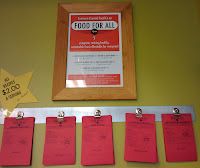
Some of my most valuable resources were recipes from the Co-Op's Food for All program. These recipes, created by Jacqueline and freely available as red recipes sheets for the taking, show you how to feed yourself and your family an all-organic meal for less than $2 per serving. Some of the recipes include meat and you can add meat to most of them but that will increase the price per serving.
To deepen my knowledge about how to spend less on food, eat healthier and more organically, I attended a free class Saturday afternoon offered by the Co-Op called "Eating Healthy on a Budget." The class happens every month and is taught by Jacqueline. (For this and other offerings at the Co-Op, visit their classes and events page on their website.)
The class included myself and seven others: four students, a mother of two young children, and two people in their 50s. During our two-hour class we were given all of the Food for All recipes, hand-outs on grains and beans and breads and lots of tips.
The big theme for the class was: buy in bulk, cook in bulk and freeze in bulk and you will save lots of time and money and will eat better, healthier food. I learned this a long time ago and somehow I had gotten out of practice. The class inspired me enough to act on what I had re-learned.
I bought a bunch of organic bulk grains and beans. I saved a ton of money. The key is to avoid food that is processed, not just frozen dinners, but canned and boxed anything. You will pay 2-4 times more to buy organic canned beans than you will to buy organic dry beans and cook them yourself.
Armed with knowledge from my Eating Healthy on a Budget class, I pre-soaked my beans in a big bowl of water overnight. Jacqueline told us that pre-soaking the beans releases nutrients and breaks down enzymes for easy digestion. If you want to save time and avoid the pre-soak, you can add a clove of garlic or kombu seaweed to each cup of dry beans and you will achieve the same result. Pretty cool!
After the beans have soaked, you can cook them in a pressure cooker, a crock pot or in a pot on the stove. I tried the pressure cooker and stop pot methods. Of course, the actual cooking time in the pressure cooker was a lot less than on the stove top, but it took a lot of time for the cold water in the pressure cooker to get hot and up to 15 lbs. of pressure. And, I found that I had a harder time controlling the texture of the cooked beans in the pressure cooker.
The kidney beans cooked in the pressure cooker were overcooked and mushy even though I cooked them per the instructions. Maybe that's because after they are done cooking, they sit in the hot water while the pressure in the cooker goes down. This has to happen before you can open the pressure cooker and get the beans out.

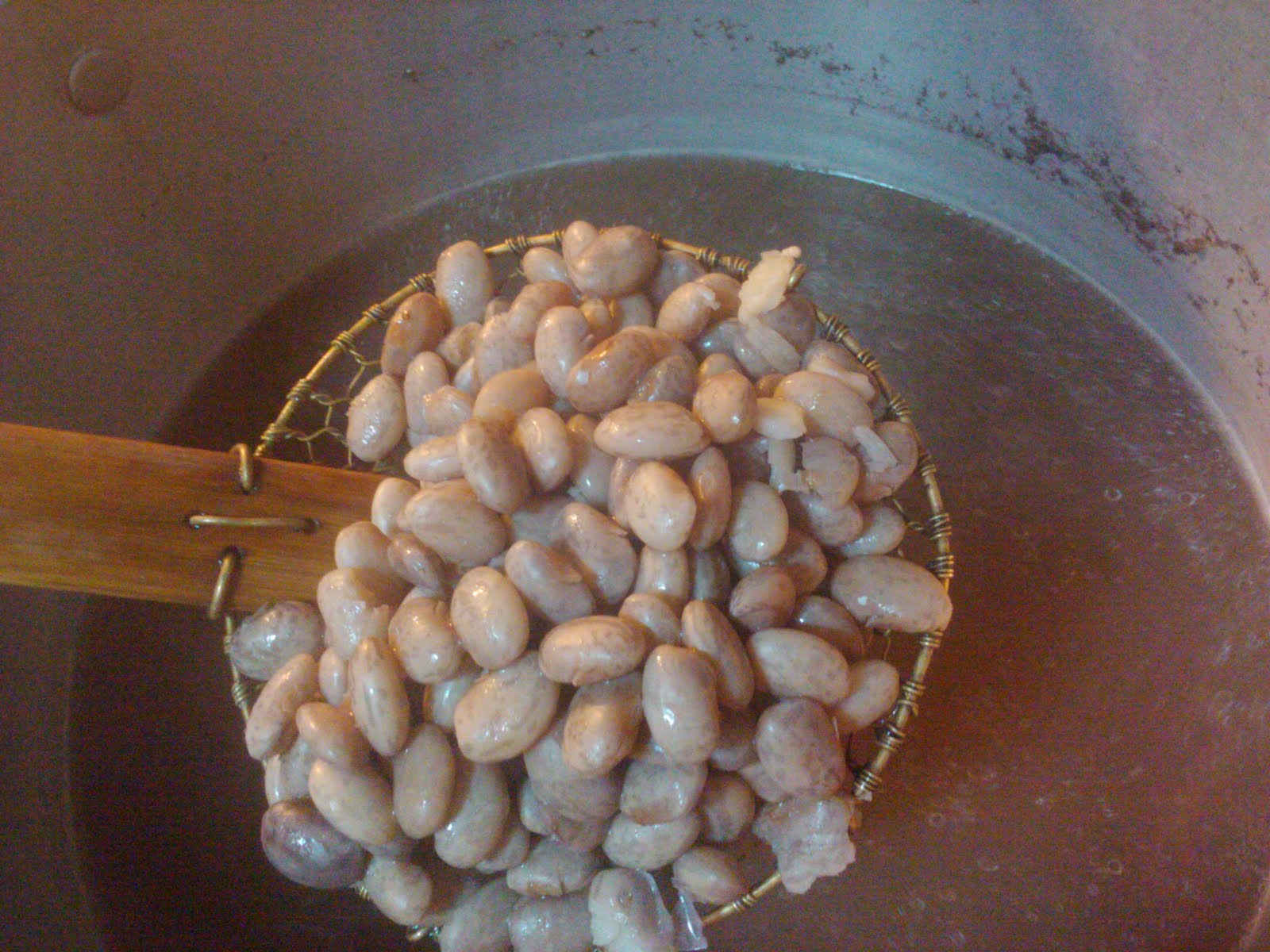
The navy beans I cooked on a pot on the stovetop (after soaking overnight) turned out perfectly! They look just like they do when I buy them in a can in the store.
I didn't mind figuring out what worked best for me. I'll eat both batches of beans.
In all, my Sunday cook-fest yielded 12 cups of kidney beans, 11 cups of navy beans and 11 cups of pinto beans. After cooking, I drained the beans, cooled them and put them in 1 1/2-cup portions in ziplock bags and froze them.
I saved a lot of money, too! For example, the 2.14 lbs. of organic dried kidney beans cost me $6.23 and made the equivalent of 8, 15oz.-cans of organic kidney beans. Those canned beans would have cost me $15.12.
My grandmothers, both of whom canned and froze and cooked from scratch, would have been proud. And so would my mother, who taught me to can and freeze when I was in junior high school.
And, thanks to the sharing, caring and innovation of the people in this community, I was given the tools that inspired me to pick-up where my mom and grandmoms left off.
I am grateful!
Kimberlie Kranich, author of this post, is director of community engagement at Illinois Public Media (WILL radio.tv.online) and may be reached here.
Well, I was ready.
Jacqueline Hannah, general manager of Common Ground Food Co-Op in Urbana, appeared. She's the one in pink in the photo below.
I had just completed a week of voluntarily eating on $4.50 a day as part of Feeding Illinois' Snap Hunger Challenge for Hunger Action Month. It took a lot of pre-planning and mining of my friends' experiences with healthy eating to survive on such a small daily food budget. I was hungry and pre-occupied with food the entire week. And I ate as healthfully as I could.
Some of my most valuable resources were recipes from the Co-Op's Food for All program. These recipes, created by Jacqueline and freely available as red recipes sheets for the taking, show you how to feed yourself and your family an all-organic meal for less than $2 per serving. Some of the recipes include meat and you can add meat to most of them but that will increase the price per serving.
To deepen my knowledge about how to spend less on food, eat healthier and more organically, I attended a free class Saturday afternoon offered by the Co-Op called "Eating Healthy on a Budget." The class happens every month and is taught by Jacqueline. (For this and other offerings at the Co-Op, visit their classes and events page on their website.)
The class included myself and seven others: four students, a mother of two young children, and two people in their 50s. During our two-hour class we were given all of the Food for All recipes, hand-outs on grains and beans and breads and lots of tips.
The big theme for the class was: buy in bulk, cook in bulk and freeze in bulk and you will save lots of time and money and will eat better, healthier food. I learned this a long time ago and somehow I had gotten out of practice. The class inspired me enough to act on what I had re-learned.
I bought a bunch of organic bulk grains and beans. I saved a ton of money. The key is to avoid food that is processed, not just frozen dinners, but canned and boxed anything. You will pay 2-4 times more to buy organic canned beans than you will to buy organic dry beans and cook them yourself.
Armed with knowledge from my Eating Healthy on a Budget class, I pre-soaked my beans in a big bowl of water overnight. Jacqueline told us that pre-soaking the beans releases nutrients and breaks down enzymes for easy digestion. If you want to save time and avoid the pre-soak, you can add a clove of garlic or kombu seaweed to each cup of dry beans and you will achieve the same result. Pretty cool!
After the beans have soaked, you can cook them in a pressure cooker, a crock pot or in a pot on the stove. I tried the pressure cooker and stop pot methods. Of course, the actual cooking time in the pressure cooker was a lot less than on the stove top, but it took a lot of time for the cold water in the pressure cooker to get hot and up to 15 lbs. of pressure. And, I found that I had a harder time controlling the texture of the cooked beans in the pressure cooker.
The kidney beans cooked in the pressure cooker were overcooked and mushy even though I cooked them per the instructions. Maybe that's because after they are done cooking, they sit in the hot water while the pressure in the cooker goes down. This has to happen before you can open the pressure cooker and get the beans out.

The navy beans I cooked on a pot on the stovetop (after soaking overnight) turned out perfectly! They look just like they do when I buy them in a can in the store.
I didn't mind figuring out what worked best for me. I'll eat both batches of beans.
In all, my Sunday cook-fest yielded 12 cups of kidney beans, 11 cups of navy beans and 11 cups of pinto beans. After cooking, I drained the beans, cooled them and put them in 1 1/2-cup portions in ziplock bags and froze them.
I saved a lot of money, too! For example, the 2.14 lbs. of organic dried kidney beans cost me $6.23 and made the equivalent of 8, 15oz.-cans of organic kidney beans. Those canned beans would have cost me $15.12.
My grandmothers, both of whom canned and froze and cooked from scratch, would have been proud. And so would my mother, who taught me to can and freeze when I was in junior high school.
And, thanks to the sharing, caring and innovation of the people in this community, I was given the tools that inspired me to pick-up where my mom and grandmoms left off.
I am grateful!
Kimberlie Kranich, author of this post, is director of community engagement at Illinois Public Media (WILL radio.tv.online) and may be reached here.
Subscribe to:
Comments (Atom)